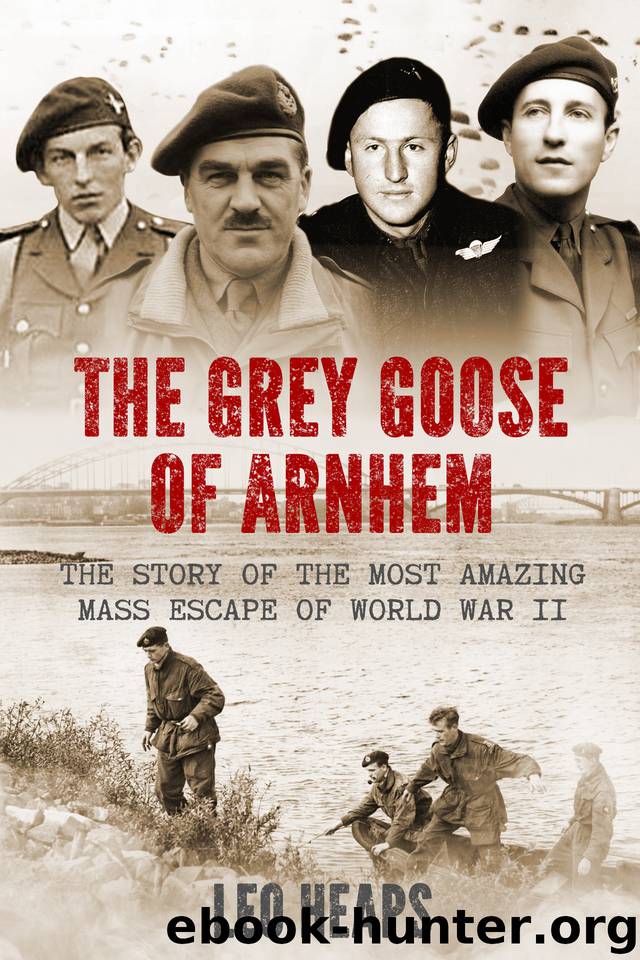
The Grey Goose of Arnhem: The Story of the Most Amazing Mass Escape of World War II by Heaps Leo
Author:Heaps, Leo [Heaps, Leo]
Language: eng
Format: epub
Publisher: Sapere Books
Published: 2020-04-04T16:00:00+00:00
THE GREY GOOSE
The creeks of the Biesbosch twist and turn, come to a dead end, lose themselves among the tall willows or thrust out into tongue-like lagoons that become part of the shapeless swamps of this hundred-mile-square watershed. The great veinwork of muddy water is constantly pumped in and out by the powerful tides that run down the Merwede River. The only signs of human life were some isolated huts once used for duck hunting in more peaceful times. But now the huts were derelict, deserted except for the occasional fugitive fleeing the Germans. A man could be swallowed up by the Biesbosch without a trace. Bogs and quicksand made walking treacherous, almost impossible. Only small canoes of shallow draft would slide across the reeds and penetrate the small gaps between the overhanging willow trees. In winter the place was an icy quagmire shrouded in almost continual fog.
A small group of men who grew up on the waters of the Merwede decided in October, 1944, to form their own clandestine transportation system through the Biesbosch. When the moon and tide were favourable, they paddled their canoes from Sliedrecht to Lage Zwaluwe, carrying evaders out of occupied Holland. Normally, the journey one way took four hours, but sometimes it could take days. German machine gun posts and sunken cables at the Kop van ’tLand did little to deter the river men, who became known as “the crossers.” They dressed alike in thick woollen sweaters and scarves, heavy coats and boots, caps and gloves. By the end of October snow and sleet, often whipped up over the river by a strong northwest wind, made the canoe crossing more hazardous than usual. But the ferrying service continued regardless of the weather. Only the tide dictated the hour of departure.
Jan van der Ley (Lange Jan), a tall, blond man with an Australian mother and Dutch father, knew the river since childhood. Jan Visser (Grey Jan), a road contractor from Sliedrecht with premature grey hair, spent his youth hunting geese in the swamps. Cheerful Jan Landgraaf (Deaf Jan), a flat-nosed, mechanical engineer, had one great advantage over everyone else. Born deaf, he heard nothing on his canoe journeys and therefore always thought everything was fine. Koos Meijer (Koos), operated a river boat since 1923, named Janna after his wife, and figured he knew the river as well as anyone. For safety in the fog he wore a compass strapped to his wrist. Cornelis van Woerkom (Bald Kees), a quiet, bespectacled marine surveyor, preferred to travel alone. Jan Rombout, another river captain, took the name of Staat while Ko Bakker became Alblas. These were the guides who went up and down twenty-five miles of river night after night. Only the river men would be able to bring out the last of the evaders.
At dusk on February 5, 1945, Simon Kadijk, a farmer, walked down to a particularly prominent poplar tree that towered on the edge of his riverside property on the Beneden Merwede. With a mallet
Download
This site does not store any files on its server. We only index and link to content provided by other sites. Please contact the content providers to delete copyright contents if any and email us, we'll remove relevant links or contents immediately.
Waking Up in Heaven: A True Story of Brokenness, Heaven, and Life Again by McVea Crystal & Tresniowski Alex(37811)
Empire of the Sikhs by Patwant Singh(23086)
We're Going to Need More Wine by Gabrielle Union(19046)
Hans Sturm: A Soldier's Odyssey on the Eastern Front by Gordon Williamson(18592)
Leonardo da Vinci by Walter Isaacson(13336)
The Radium Girls by Kate Moore(12028)
Tools of Titans by Timothy Ferriss(8396)
Educated by Tara Westover(8054)
How to Be a Bawse: A Guide to Conquering Life by Lilly Singh(7486)
Permanent Record by Edward Snowden(5847)
The Last Black Unicorn by Tiffany Haddish(5636)
The Rise and Fall of Senator Joe McCarthy by James Cross Giblin(5280)
Promise Me, Dad by Joe Biden(5153)
The Wind in My Hair by Masih Alinejad(5095)
A Higher Loyalty: Truth, Lies, and Leadership by James Comey(4964)
The Crown by Robert Lacey(4817)
The Iron Duke by The Iron Duke(4356)
Joan of Arc by Mary Gordon(4112)
Stalin by Stephen Kotkin(3966)
